Powder vs Flakes vs Granules – Which Form is Best for Your Business?
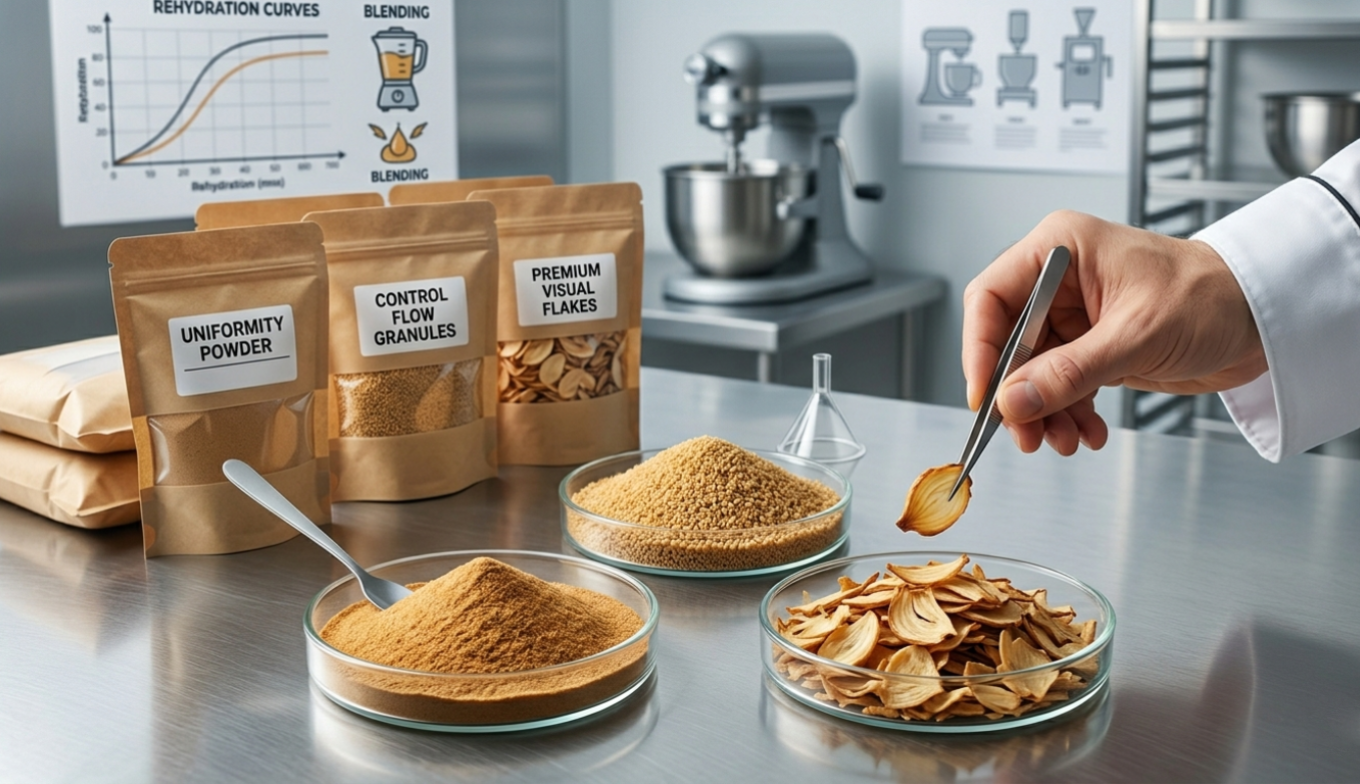
In the world of food manufacturing, the form of an ingredient can be just as important as the ingredient itself. Whether you are producing instant foods, snacks, seasonings, or ready-to-eat meals, choosing between powder, flakes, and granules can significantly impact your product’s quality, processing efficiency, and customer experience.
Each form of dehydrated ingredient offers unique advantages and is suited to specific applications. Understanding these differences is key to making the right decision for your business.
Let’s explore what sets powders, flakes, and granules apart—and how to determine which one is best for your needs.
Understanding the Three Forms
Before diving into comparisons, it’s important to define each form:
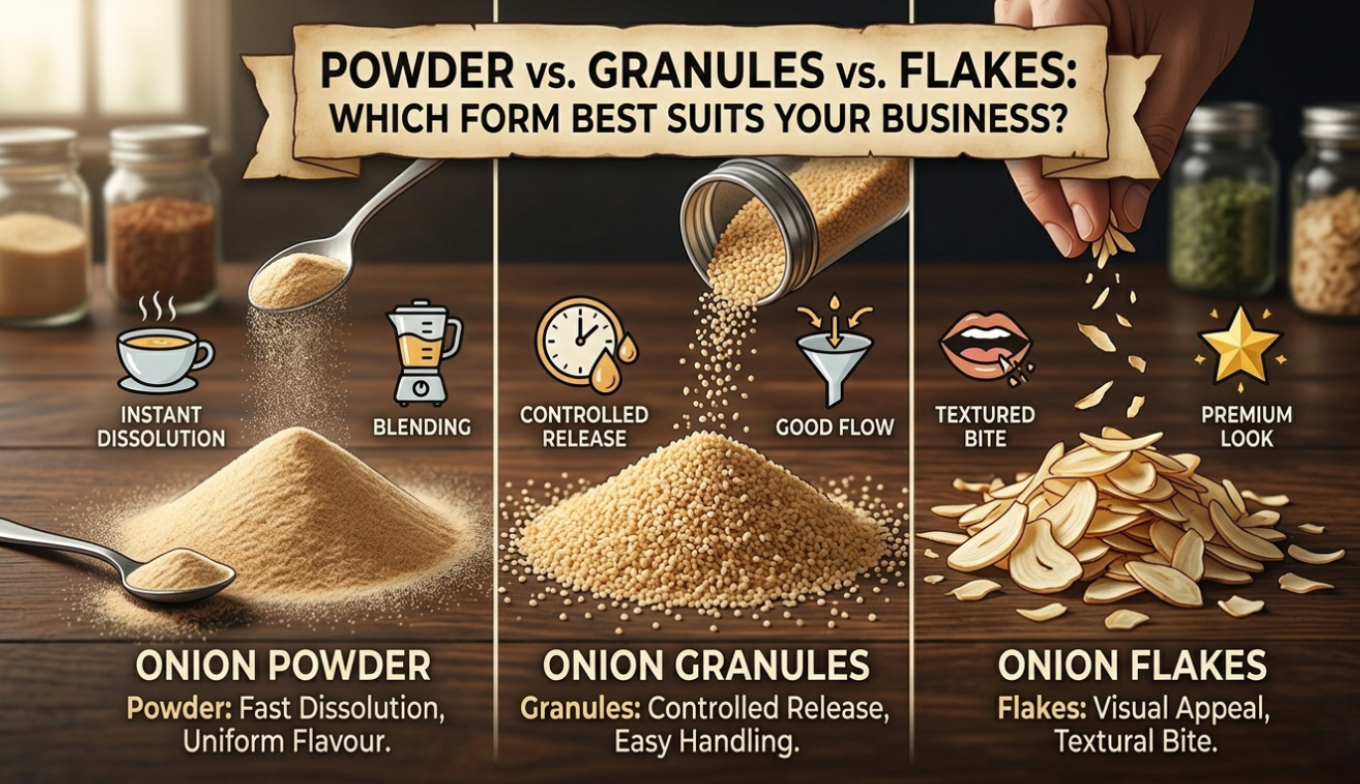
Each form differs in particle size, texture, solubility, and application, which directly affects performance in food manufacturing.
1. Powder: Best for Uniformity and Instant Blending
Powdered ingredients are widely used across the food industry due to their fine texture and high solubility. They dissolve or disperse quickly, making them ideal for products that require a smooth and consistent finish.
Key Advantages:
Ideal Applications:
Limitations:
When to Choose Powder:
If your product requires a smooth consistency, rapid solubility, and consistent flavor distribution, powder is the best option. It’s particularly valuable for high-speed manufacturing processes where uniformity is critical.
2. Flakes: Best for Visual Appeal and Texture
Flakes offer a more natural and visually appealing form of dehydrated ingredients. They retain some of the original shape and structure, making them ideal for products where appearance and texture play a key role.
Key Advantages:
Ideal Applications:
Limitations:
When to Choose Flakes:
Flakes are the best choice when your product needs to look and feel premium. If visual identity and texture are important to your brand—such as in gourmet meals or packaged foods—flakes can significantly enhance the consumer experience.
3. Granules: The Balance Between Function and Form
Granules sit between powders and flakes, offering a balance of solubility, texture, and control. They are coarse enough to avoid dust issues but fine enough to disperse effectively.
Key Advantages:
Ideal Applications:
Limitations:
When to Choose Granules:
Granules are ideal when you need a practical, easy-to-handle ingredient that balances performance and appearance. They are especially useful in large-scale manufacturing where flowability and consistency are important.
Key Factors to Consider When Choosing
Selecting the right form depends on several business and product-related factors. Here are the most important considerations:
1. Product Type
Your end product plays a major role in determining the ideal form:
2. Processing Requirements
Consider how the ingredient will be handled during production:
3. Texture and Mouthfeel
Consumer experience matters:
4. Storage and Handling
Each form behaves differently:
5. Cost Efficiency
While all three forms are cost-effective compared to fresh ingredients, there can be differences:
Industry Use Case Examples
To better understand how these forms are used in real-world scenarios, consider the following:
Many manufacturers even use a combination of forms to achieve the perfect balance of taste, texture, and functionality.
Can You Use a Hybrid Approach?
Absolutely. In fact, many successful food products rely on blending different forms of dehydrated ingredients. For example:
This hybrid approach allows businesses to leverage the strengths of each form while minimizing their limitations.
Conclusion
Choosing between powder, flakes, and granules is not a one-size-fits-all decision. Each form offers distinct advantages that cater to different product requirements, manufacturing processes, and consumer expectations.
For businesses in the food manufacturing industry, the key is to align ingredient form with product goals. By carefully evaluating your needs—whether it’s speed, appearance, texture, or efficiency—you can select the form that delivers the best results.
Ultimately, the right choice will not only improve your production process but also enhance the quality and appeal of your final product, giving your business a competitive edge in an increasingly demanding market.
2 Comments
The Growing Demand for Dehydrated Vegetable Powders in Food Processing - Ziva Roots
[…] Powder vs Flakes vs Granules – Which Form is Best for Your Business? […]
What Are Dehydrated Vegetables and Why the Food Industry Depends on Them - Ziva Roots
[…] Powder vs Flakes vs Granules – Which Form is Best for Your Business? […]