The global food landscape is undergoing a dramatic transformation. As we move toward 2030, challenges such as food security, climate change, and increasingly busy lifestyles are forcing the food industry to rethink how nutrition is produced, preserved, and delivered.
Zivaroots is a dehydrated food ingredients company that supplies vegetable and fruit powders, flakes, granules, and slices in bulk to food industries across India.
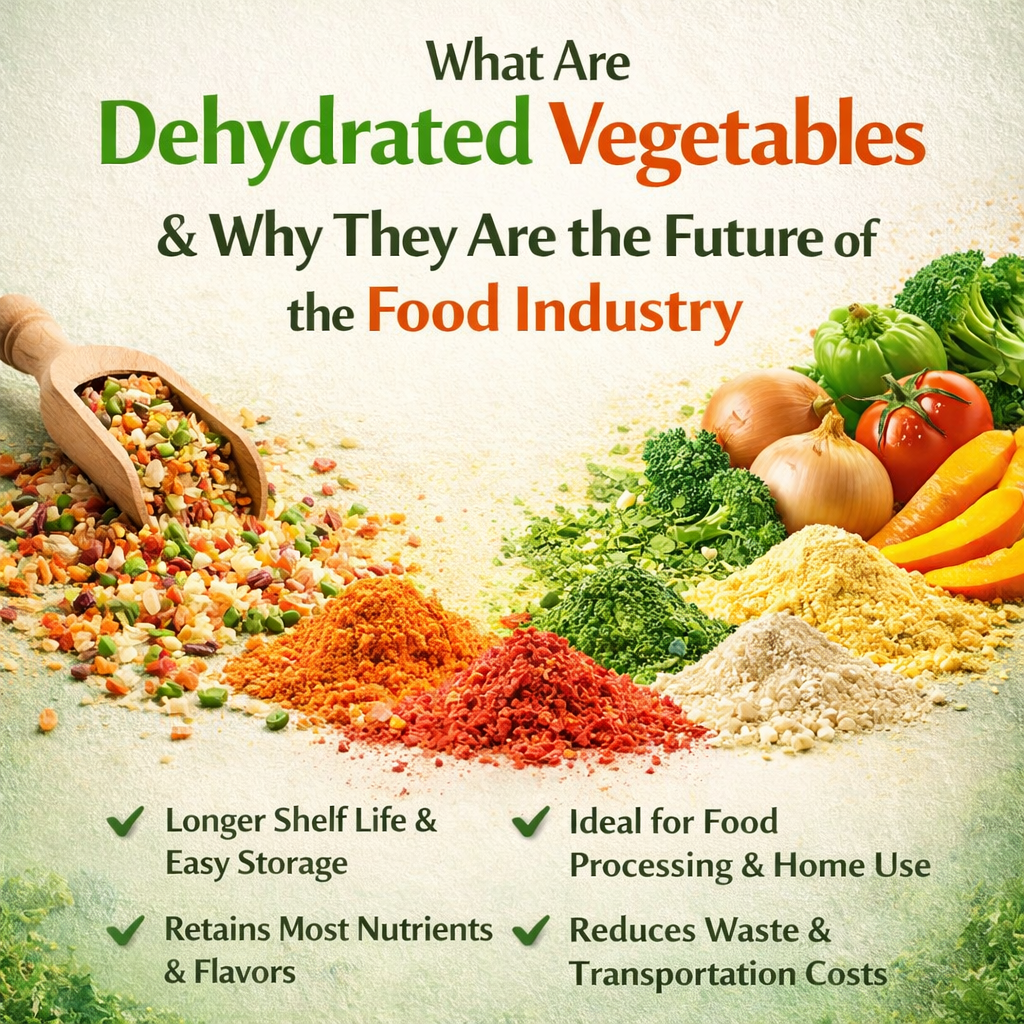
The global food landscape is undergoing a seismic shift. As we march toward 2030, the challenges of food security, climate change, and hyper-busy lifestyles are forcing a re-evaluation of how we consume nutrition. Standing at the forefront of this revolution is a technology as old as civilization yet as modern as space travel: Dehydration.
Dehydrated vegetables are no longer just “emergency rations” or soup mix fillers. They have evolved into a $70 billion global powerhouse that is redefining efficiency, sustainability, and health in the food industry.
At its core, dehydration is the process of removing nearly all the water content (moisture) from fresh vegetables. By reducing water activity—usually to levels below 10%—the environment becomes inhospitable for the bacteria, yeast, and mold that cause spoilage.
The Modern Dehydration Toolkit
While ancient civilizations used the sun, today’s food industry utilizes sophisticated technology to preserve the “soul” of the vegetable:
Air/Drum Drying: Traditional hot air circulation. Cost-effective and widely used for hardy vegetables like carrots and onions.
Freeze-Drying (Lyophilization): The gold standard. Vegetables are frozen, and water is removed via sublimation (turning ice directly into vapor). This preserves up to 97% of nutritional value, along with the original color and texture.
Vacuum Drying: Drying at lower temperatures in a vacuum to protect heat-sensitive vitamins and flavors.
Spray Drying: Ideal for creating vegetable powders (like spinach or beetroot powder) used in the “clean label” coloring and functional food markets.
The “Future of Food” isn’t just about what we eat, but how that food impacts the planet and our schedules. Here is why dehydration is winning:
Global food waste is a trillion-dollar problem. Approximately one-third of all food produced is lost or wasted. Fresh vegetables are particularly vulnerable due to their short shelf life. Dehydration allows processors to “lock in” seasonal surpluses and “imperfect” produce (ugly vegetables) that would otherwise be discarded, turning them into shelf-stable ingredients that last for 12–24 months.
Fresh vegetables are mostly water (often over 90%). Shipping fresh produce means spending massive amounts of fuel to transport water.
Weight Reduction: Dehydration reduces weight by nearly 80–90%.
No Cold Chain: Unlike frozen or fresh produce, dehydrated vegetables do not require refrigerated transport or storage.
This drastically lowers the carbon footprint of the supply chain and reduces logistics costs for manufacturers.
Modern consumers are fleeing from chemical preservatives. Dehydrated vegetables are a “clean label” dream because the process of moisture removal is the preservative. No additives are needed. Furthermore, because the water is gone, the nutrients are concentrated. A small scoop of dehydrated kale powder can offer the fiber and mineral equivalent of a large bunch of fresh leaves.
Urbanization has created a “time-poor” generation. Dehydrated vegetables are the backbone of the booming Ready-to-Cook (RTC) and Ready-to-Eat (RTE) sectors. They provide the crunch in healthy snacks, the nutrition in instant noodles, and the flavor in gourmet meal kits—all without the need for washing, peeling, or chopping.
Market Trends: What to Watch in 2026 and Beyond
According to recent industry forecasts, the dehydrated vegetable market is expected to grow at a CAGR of over 5.5% through 2030. Key trends include:
Custom Formats: Moving beyond “flakes” to specific powders, granules, and “micro-cuts” for specialized industrial applications.
Exotic Varieties: Growing demand for dehydrated ginger, garlic, and medicinal herbs for the “nutraceutical” and Ayurvedic markets.
Plant-Based Meat: Dehydrated vegetable fibers and powders are being used as natural binders and flavor carriers in the next generation of vegan meats.
Dehydrated vegetables represent a rare win-win in the industrial world. They offer economic efficiency for manufacturers, unbeatable convenience for consumers, and a sustainable path for the planet. As we look toward a future with 9 billion people to feed, the ability to store the earth’s bounty without a ticking clock is not just an industry trend—it is a global necessity.
Contact Details & Business Inquiries
For high-quality dehydrated vegetable solutions and industry partnerships, reach out to the experts at Ziva Roots.
Dehydrated Vegetables, Food Industry Trends 2026, Sustainable Food Preservation, Freeze-Dried Vegetables, Vegetable Powders, Food Waste Reduction, Ziva Roots, Dehydrated Onion and Garlic, Ready-to-Eat Ingredients.
About Zivaroots Zivaroots focuses on transforming fresh farm produce into high-quality dehydrated ingredients that can be used by food industries, exporters, and bulk buyers. The company works on farm sourcing, controlled dehydration processing, and bulk supply to maintain consistent quality and long shelf life.
What Zivaroots Provides
Zivaroots supplies different types of dehydrated food ingredients, such as:
Vegetable powders – fine powders used in sauces, spices, and processed foods
Vegetable flakes – dried vegetable pieces that rehydrate easily
Granules & minced vegetables – controlled particle sizes for mixing in food production
Vegetable slices & cuts – dehydrated slices for industrial food applications
Fruit powders & pieces – used in beverages, bakery products, and health foods
Key Features of Zivaroots
Bulk B2B supply for manufacturers and exporters
Low-moisture dehydration to retain taste and nutrition
Custom specifications like powder mesh sizes and cuts
Clean label ingredients (no fillers or artificial colors)
Certifications and standards such as FSSAI, ISO, and HACCP for quality and safety
Phone: +91 9650552228 | Email: info@zivaroots.com | Website: https://www.zivaroots.com